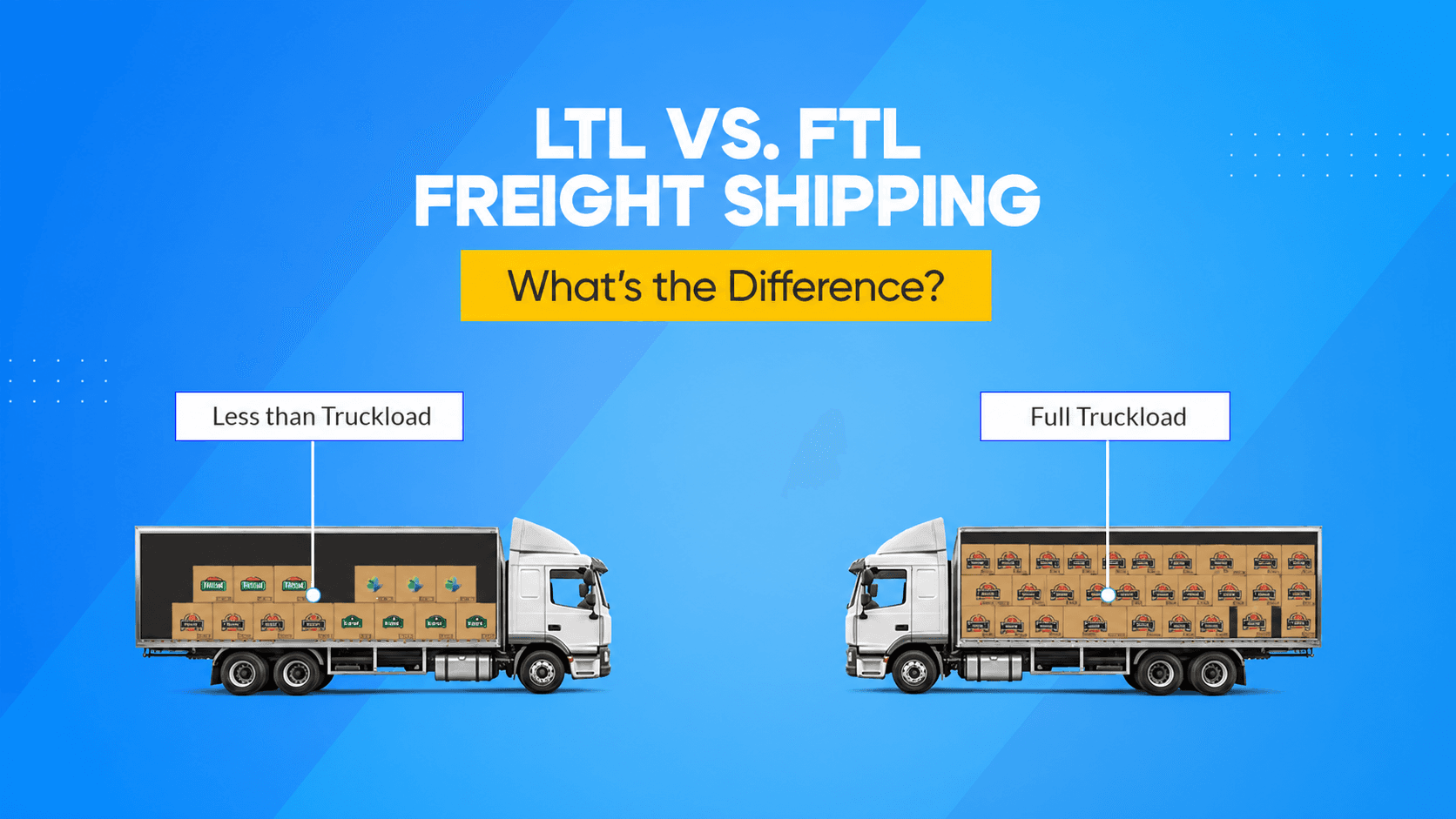
When you need to move cargo by road in India, one of the first decisions you face is whether to book a Full Truck Load (FTL) or a Less-than-Truck Load (LTL) shipment. It sounds like a simple size question, but the right choice depends on several factors beyond just how much cargo you have. Choose wrong and you either overpay for unused truck space or accept slower transit times you could have avoided.
This guide gives you a clear framework to make the decision confidently.
What Is FTL (Full Truck Load)?
In an FTL shipment, you hire an entire truck for your cargo exclusively. The truck goes directly from your origin to your destination — no other shipper's goods are loaded, and there are no intermediate stops.
FTL is typically used when:
- Your cargo fills 70–100% of a standard truck's capacity
- You need faster, more predictable transit (no detours for multi-stop drops)
- Your goods are fragile, high-value, or require special handling
- You want to minimise the number of times your cargo is handled
A standard closed-body truck (32 feet) can carry approximately 7,000–8,000 kg and 400–450 cubic feet of cargo. Larger multi-axle trucks can carry up to 25 tonnes.
What Is LTL (Less-than-Truck Load)?
In an LTL shipment (also called "part load" in India), your cargo shares a truck with consignments from other shippers going to the same or nearby destinations. A logistics company like PrimePathCargo consolidates multiple smaller shipments into one truck, and you pay only for the space and weight your cargo uses.
LTL is typically used when:
- Your cargo is smaller than what would fill a full truck (under 4,000–5,000 kg as a rough guide)
- Your budget matters more than absolute transit speed
- Your delivery destination is a major hub or city served by regular consolidated runs
- You ship frequently in smaller quantities
Key Differences at a Glance
| Factor | FTL | LTL |
|---|---|---|
| Cost | Higher absolute cost; lower cost-per-tonne for large loads | Lower absolute cost; higher cost-per-tonne for small loads |
| Transit Time | Faster — direct origin-to-destination | Slower — consolidation adds 12–24 hours typically |
| Handling | Minimal — loaded once, delivered once | More handling — loaded, unloaded, sorted at hub |
| Damage Risk | Lower | Slightly higher (more handling points) |
| Flexibility | Fixed booking | More flexible scheduling |
| Best For | Large volumes, time-critical or fragile cargo | Smaller volumes, cost-conscious shippers |
How to Decide: A Practical Framework
Step 1: Calculate Your Cargo Volume and Weight
Get the dimensions (L × W × H in cm) and weight (kg) of your shipment. Calculate the volumetric weight:
Volumetric weight (kg) = (L × W × H in cm³) ÷ 4,000
Freight is charged on whichever is higher — actual weight or volumetric weight.
Step 2: Apply the 70% Rule
If your cargo would fill more than 65–70% of a standard truck, FTL almost always works out cheaper and faster. You are paying for most of the truck anyway — you may as well get exclusivity, speed, and lower handling.
If your cargo is below 50% of truck capacity, LTL will likely save money.
The 50–70% range is where the decision gets nuanced — and where comparing quotes from both options pays off.
Step 3: Factor in Transit Time Requirements
If your delivery is time-critical — supplying an assembly line, replenishing a retail promotion, or meeting a customs deadline — FTL's direct routing is usually worth the premium. A single delayed LTL consolidation at a hub can push your delivery by 24–48 hours.
Step 4: Consider Cargo Nature and Value
High-value electronics, delicate machinery, and goods in retail-ready packaging benefit from FTL's minimal handling, even at lower volumes. The cost of a single damage claim often exceeds the savings from choosing LTL.
Cost Comparison Example
Let's say you are moving 3,000 kg of machinery parts from Ghaziabad to Bengaluru.
- LTL rate: ₹35–45 per kg → ₹1,05,000–₹1,35,000
- FTL (32ft truck): ₹55,000–₹70,000 for the full truck
In this scenario, FTL is cheaper even though you are not filling the truck — because LTL per-kg rates are higher.
Note: Rates are illustrative. Always get specific quotes based on your actual cargo and lanes.
PrimePathCargo's Approach
We run daily LTL consolidations on major lanes from Delhi NCR to Mumbai, Chennai, Bengaluru, Hyderabad, Ahmedabad, and Kolkata. For FTL, we offer a managed fleet of closed-body, open-body, and flatbed vehicles with GPS tracking.
When you request a quote, we always show you both options with transit time comparisons — so you can make the informed choice, not just the default one.
Summary
- Choose FTL if you have a large volume, tight timeline, fragile goods, or when the FTL rate undercuts LTL per-tonne (more common than people expect).
- Choose LTL if you have a smaller, non-urgent consignment going to a major hub city and cost efficiency is your priority.
- When in doubt, get both quotes — the right answer is rarely obvious without comparing numbers.
Ready to move your cargo? Request a quote and we will walk you through the best option for your specific lane and volume.